
"Awesome app, has saved so much time enriching alt text and category metafields. The audit makes it super easy to spot gaps and quickly action without the manual effort. Dev team are great too, super responsive and easy to work with."
Product Pelican - native PIM for Shopify
Good product data is
good business.
Product Pelican is the Shopify-native PIM for the agentic commerce era.
- Audit, enrich and govern your product data and collections
- Lives 100% in Shopify
- No spreadsheets required.
↑ See Pelican in action
What Shopify stores are saying.
"The AI-powered audit quickly highlights gaps in product listings and provides clear, actionable suggestions to optimise content for better visibility across different Geo Targeted search results. It's a great tool if you're looking to enhance discoverability and reach a wider audience without spending hours on manual updates. Also the developer is fantastic to work with. Responsive, knowledgeable."
"Awesome app and saved me so much time updating alt tags and other product attributes. Highly recommend!"
The model isn't the differentiator.
Your data is.
Agentic commerce isn't coming — it's here. The merchants who win this decade will have one thing in common: clean, structured, well-attributed product data. Pelican gets you there.
"Catalog-powered AI search converts 2× higher than general AI. The actual moat is what the agent is pulling from. The model isn't the differentiator. Your data is."
Khalid Chao · Senior Solutions Engineer @ ShopifyEdit product
Generate, review, apply — in bulk.
Generate image ALT text, product titles & descriptions. Edit the suggestions in place.
Hit Generate All for bulk suggestions. Hit Save All when you're confident. The whole thing is built around merchant control — Pelican never changes anything you haven't approved.

Confidence, not guesswork.
Every category suggestion comes with a confidence rating — High, Medium, or worth-a-second-look. Run Suggest All across all your products in one go.
The job that used to take a week takes less than an hour.
Relationships your merchandiser would build.
Colour options grouped. "Pair it with" pairs surfaced. "Complete the set" sets stitched. Pelican reads your catalogue's signals — names, SKUs, attributes, taxonomy — and builds the relationships natively in Shopify.
Better cross-sell, better upsell, better discoverability. Native to the platform, not bolted on through a recommendation widget that breaks the moment your theme changes.
Generate and Manage Product FAQs — in bulk.
Your customers are asking ChatGPT, Claude & Gemini about your products.
Generate the answers so the LLMs recommend your products.
The data debt, finally paid off.
Missing SKUs. Missing barcodes. Missing images. The kind of stuff that sits quietly broken in every catalogue until ChatGPT recommends a competitor's product instead of yours.
Pelican spots the gaps, suggests sensible fixes — pulled from product data, vendor data, variant data — and applies them in bulk. The boring work, automated.
New features shipping every week.
This is the bit that gets us excited. Native Shopify automation that nobody else can ship — because nobody else lives where the data lives.
Product stitching.
Automatically link related products — colour options, "pair it with", "complete the set". Pelican reads your catalogue and builds the relationships for you, the way a good merchandiser would. Cross-sells, upsells and discoverability without a single manual link.
Native unlock. Shopify product relationships, automated.
Category metafields in bulk.
Shopify's product taxonomy is incredible — but the category metafields underneath it are a minefield. Pelican now populates them automatically in bulk, perfectly aligned with the official taxonomy. Better filters, better search, better Shop, better Google integration. All native.
Headache avoided. Using AI the way it's meant to be used.
Bulk gap fixes.
Missing SKUs. Missing barcodes. Missing images. The data debt every catalogue carries quietly until something breaks. Pelican now finds the gaps, suggests the fixes, and applies them at scale. Less spreadsheet archaeology, more shipping.
Three audits. One workflow. Done.
You write the rules. Pelican follows them.
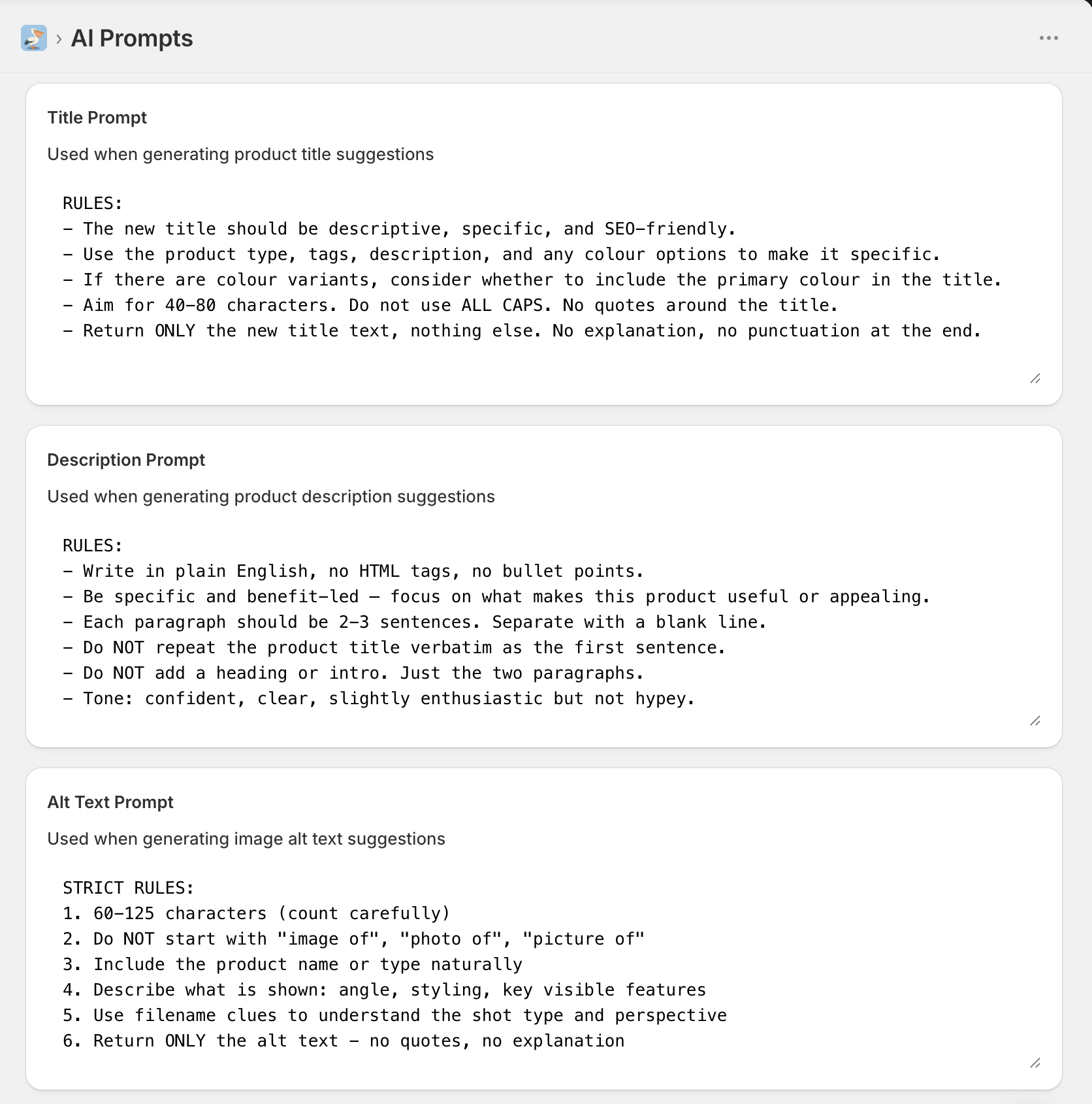
Pelican's AI isn't a black box. Every prompt — for titles, descriptions, alt text, categories — is yours to edit. Add brand voice. Add shipping messaging. Add merchandising rules. Add what to never say.
- Title promptTone, structure, vendor handling.
- Description promptVoice, shipping rules, USPs.
- Alt text promptDetail level, accessibility tone.
- Category promptRestrictions, preferences, exceptions.
Update the prompt, regenerate the suggestions, ship. Reset to defaults whenever you want.
How this got built.
I didn't set out to build a PIM. I was vibe-coding a few product audits for Shopify merchants — completeness checks, taxonomy gaps, SEO holes. Then I added AI to fix what the audits found. Then bulk actions. Then stitching. Then governance.
One day I realised: oh shit, I've accidentally built a PIM — and it lives 100% inside Shopify.
Turns out the right way to build one was never to build a separate system. It was to build it where the data already lives — with proper AI guard rails, and ultimate control left in the merchant's hands.
Lots of opinions. One consensus.
GEO. UCP. ACP. AEO. SEO. The acronyms are multiplying weekly, and every free scanner gives a different score on the same store.
Underneath all of it, every scoring tool is measuring the same thing: is your product data rich, accurate, structured, and honest?
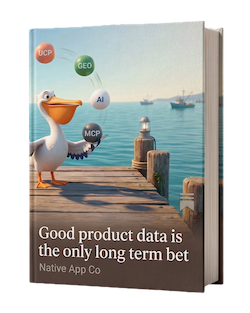
Protocols come and go. Great product data outlasts all of it. That's the only long-term bet — and the playbook below is how we think about getting there.
The score doesn't matter.
What you do next does.
"AI readiness tools are popping up everywhere. But what does it actually mean for your Shopify store? And how do you prioritise what to do?"
Read the playbook →Where are we going.
Build a catalogue worth recommending.
Free to install. Native to Shopify. Built by people who've been in the ecosystem for fourteen years.
Install Product Pelican →